
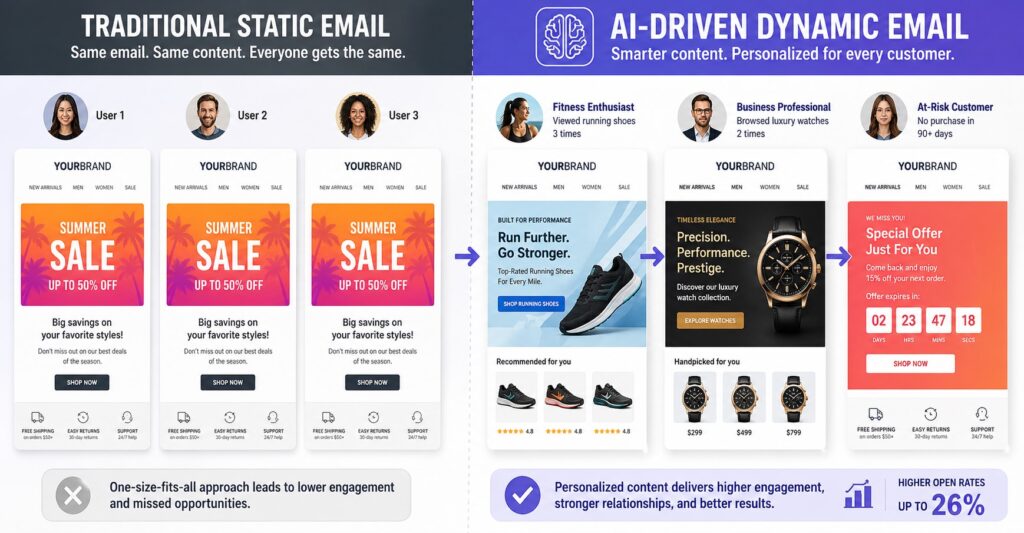
In today’s saturated digital landscape, the “spray and pray” method of email marketing is officially dead. Modern consumers don’t just prefer personalization; they demand it. AI-powered email personalization has emerged as the ultimate bridge between massive reach and intimate relevance. By leveraging machine learning in emails, brands can now move beyond “Hello ” to deliver 1-to-1 experiences to millions of subscribers simultaneously. Recent data suggests that AI-driven campaigns can boost open rates by up to 26%, transforming email from a static broadcast channel into a dynamic revenue engine driven by behavioral personalization.
- Hyper-Relevance: Deliver content based on real-time user intent and past actions.
- Operational Efficiency: Automate complex segmentation that would take humans weeks to perform.
- Increased ROI: Drive higher conversions by matching the right product with the right user at the optimal time.
What is AI-Powered Email Personalization?
AI-powered email personalization is the process of using artificial intelligence and machine learning algorithms to automate the creation, timing, and targeting of email content for individual recipients. Unlike traditional automation, which follows rigid “if-then” rules, AI learns from vast datasets to predict what a user wants next. It integrates with customer data platforms to analyze every touchpoint, ensuring that every email sent is a reflection of the user journey mapping.
How AI Transforms Traditional Email Marketing
Traditional marketing relies on broad demographic buckets. AI flips the script by focusing on individual behavior. Instead of sending a “Summer Sale” email to everyone, AI identifies which users are looking at sandals, which are browsing raincoats, and which haven’t opened an email in thirty days, adjusting the subject line and content accordingly.
Key Components: From Data to Dynamic Delivery
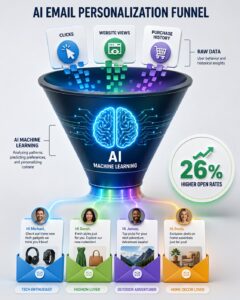
The engine behind this technology consists of three core pillars: data ingestion (collecting clicks and purchases), predictive modeling (deciding what to send), and dynamic delivery (injecting real-time content at the moment of open).
Benefits of Email Personalization at Scale
Scaling personalization isn’t just about “doing more”; it’s about doing it better without increasing your team’s workload. For sectors like BFSI and e-commerce, where customer trust is paramount, scale email personalization strategies build long-term loyalty and drive measurable revenue attribution emails.
Boosting Engagement and Conversions
When an email feels like a personal recommendation from a friend, click-through rates (CTR) skyrocket. AI identifies open rate prediction models to determine the exact minute a subscriber is most likely to check their inbox, ensuring your message sits at the top of the pile.
Real-World Stats and Metrics
- Revenue Growth: Personalized emails generate 6x higher transaction rates.
- Retention: Brands using AI-driven behavioral triggers see a 15% reduction in churn.
- Efficiency: Marketing teams save an average of 12.5 hours per week by automating segmentation.
How to Use AI for Email Personalization at Scale
What is the best way to use AI for email personalization at scale? The most effective approach involves integrating your email service provider with an AI engine that analyzes behavioral data. By automating the selection of subject lines, product recommendations, and send times, you can deliver 1-to-1 content to your entire database without manual intervention.
Step-by-Step Implementation
Step 1: Collect and Clean Customer Data
AI is only as good as the data you feed it. Consolidate data from your website, CRM, and social media into a single customer data platform. Ensure your “data hygiene” is high by removing inactive or duplicate contacts.
Step 2: Implement AI Segmentation
Move beyond age and location. Use AI to segment users by “Life-cycle Stage” (New, Loyal, At-Risk) and “Purchase Intent.” This allows for highly targeted drip campaign AI execution.
Setting Up Behavioral Email Triggers
Behavioral triggers are the “nudge” your customers need. If a user spends five minutes on a pricing page but doesn’t buy, AI can automatically trigger an email addressing common FAQs or offering a limited-time discount.
Scale Customer Segmentation with AI Email Tools
To scale customer segmentation with AI email tools, you must move into the realm of hyper-personalization. This involves using machine learning to predict future behavior based on past patterns—often called “lookalike modeling” for your own database.
Advanced Techniques for Hyper-Personalization
Predictive analytics can tell you which customers are likely to “churn” before they even know it. By sending a proactive re-engagement email with a personalized product recommendation engine block, you can save the relationship before it ends.
AI-Powered Dynamic Content in Email Marketing
AI-powered dynamic content in email marketing refers to email elements (images, offers, or text) that change automatically based on who is opening the email and when. If a user in Mumbai opens an email, they might see monsoon gear, while a user in Delhi sees summer wear—all from the same email template.
Building Dynamic Blocks with AI
Using marketing automation platforms, you can create “content blocks” that populate in real-time. This ensures that if a product goes out of stock after the email is sent, the recipient will see an alternative recommendation instead of a “Sold Out” page.
A/B Testing AI for Optimization
Stop manual A/B testing. AI can run hundreds of variations of a subject line or CTA simultaneously, automatically directing the winning version to the majority of your list to maximize ROI.
Best AI Tools for Personalized Email Campaigns in India
The Indian market has unique requirements, including localized pricing and integration with regional CRMs like Zoho. Below is a comparison of top tools that excel in AI-driven email campaigns.
| Tool Name | Key AI Features | India Friendliness | Best For |
|---|---|---|---|
| Zoho Campaigns | Send-time optimization, basic AI cleanup | Excellent (INR pricing) | SMEs & Startups |
| Klaviyo | Predictive analytics, churn risk modeling | High (USD, but great support) | E-commerce Brands |
| HubSpot | Adaptive testing, AI content assistant | Premium (Global standard) | B2B & BFSI |
| ActiveCampaign | Predictive sending & content | Moderate | Mid-market Scale |
Case Studies and Practical Examples
Indian e-commerce giant Nykaa utilizes real-time personalization to suggest beauty products based on previous skin-type searches. By implementing AI-driven triggers, they saw a massive uptick in repeat purchases. Similarly, global brands use open rate prediction models to ensure their newsletters hit the inbox exactly when the user is most active, often resulting in a 20-30% lift in engagement.
Frequently Asked Questions
What is the difference between automation and AI personalization?
Traditional automation follows pre-set rules (e.g., “send an email 2 days after signup”). AI-powered email personalization uses machine learning to adapt to the user’s changing behavior in real-time, making decisions based on data patterns rather than fixed schedules.
Is AI email marketing expensive for small businesses?
Not necessarily. Many platforms like Zoho Campaigns and Mailchimp offer entry-level AI features. The “cost” is often offset by the significant increase in revenue generated through better targeting and higher conversion rates.
How does AI improve email deliverability?
AI improves deliverability by monitoring engagement patterns. It identifies which users are unlikely to open your emails and suggests removing them, which protects your sender reputation and ensures you stay out of the spam folder.
Conclusion
The future of digital communication lies in AI-powered email personalization. By moving away from generic messaging and embracing data-driven, dynamic content, businesses can build deeper connections with their audience. Whether you are a startup in Bangalore or a global enterprise, the time to integrate AI into your email strategy is now. Start small with send-time optimization, and scale toward full behavioral triggers to stay ahead of the competition.
Very well explained
Very insightful