
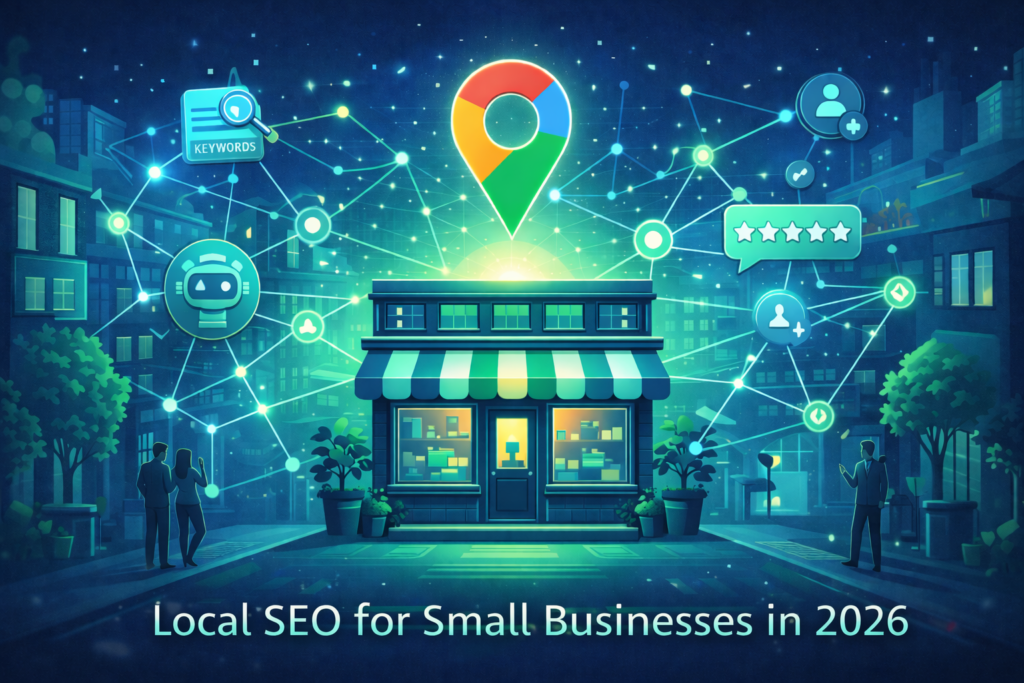
Is Your Small Business Still Playing Catch-Up in 2026’s Local Race?
In 2026, imagine a customer in Delhi pulling out their phone mid-commute, asking aloud, “Where’s the nearest eco-friendly café open right now with vegan options?” If your business isn’t optimized for this hyperlocal, AI-infused reality, you’re not just missing out—you’re invisible in a sea of 4,000+ Google Business Profile categories that demand precision. With 80% of U.S. consumers (and similar trends in India) conducting weekly local searches, and 46% of all queries bearing local intent, Local SEO for small businesses has transformed from basic tweaks into a sophisticated blend of technology, community trust, and real-time responsiveness. This isn’t hypothetical; it’s the norm. Without adapting, you risk losing 28% of “near me” searches that lead to immediate purchases. Dive into this guide to reclaim your local crown.
The Evolution of Local SEO: From Basic Listings to AI-Powered Precision in 2026
Fast-forward to 2026, and local SEO feels worlds away from the keyword-stuffing days of the early 2020s. Google’s algorithms now prioritize user-centric experiences, rewarding businesses that integrate AI tools for personalized recommendations and seamless interactions. Gone are the days of generic backlinks flooding directories—today, prominence stems from authentic engagements, verified credentials, and adaptive content that evolves with seasonal shifts like monsoons in Delhi or Diwali crowds.
Consider the shift: In 2025, community involvement edged out quantity-focused links; by 2026, AI overlays amplify this, predicting behaviors like voice searches for urgent needs (“plumber near me during floods”). Detailed reviews remain king, but now they’re paired with quick-response metrics tracked via Google’s new Verified badge, consolidating programs like Google Guaranteed into a single trust indicator. Let’s contrast yesterday’s pitfalls with tomorrow’s wins.
| Factor | The Old Way (Pre-2025) | The New Way (2026 Reality) |
|---|---|---|
| Categories & Profiles | Broad selections like “Restaurant”; manual edits prone to errors. | Hyper-specific primaries (e.g., “Vegan Café Near Metro Station”); automated audits via AI tools ensure consistency across 4,000+ options . |
| Backlinks & Signals | Volume over quality; irrelevant directory spam. | Strategic, local partnerships and AI-curated citations; behavioral signals like clicks on low positions (worth 10x more) drive rankings. |
| Content & Reviews | Static pages; superficial star ratings. | Conversational, voice-optimized FAQs; incentivized detailed reviews tied to the Google Verified badge for instant trust-building. |
| Trends & Tech | Basic mobile optimization; limited personalization. | AI-driven hyperlocal content clusters; integration with Local Services Ads for pay-per-verified-lead campaigns. |
Core Pillars of Local SEO Success: Your 2026 Action Plan
Building traction in 2026 demands a trifecta of technical prowess, human touch, and predictive analytics. These aren’t abstract ideas—they’re battle-tested local SEO tips for small businesses proven to elevate your profile amid fierce competition.
1. Master Your Google Business Profile: The AI-Enhanced Hub
Your Google Business Profile (GBP) is the cornerstone of 2026’s local ecosystem, now fortified with AI-assisted verification and dynamic updates. With over 4,000 categories to choose from, selecting the right primary one (e.g., “Eco-Friendly Bakery” instead of “Bakery”) can boost relevance scores by up to 30%, per recent benchmarks (https://webpage-source-14). Verification unlocks exclusive perks like priority in the Local 3-Pack and integration with Google’s Unified Verified Badge, signaling reliability to users and algorithms alike.
Actionable Steps for GBP Optimization:
- Precise Category Selection: Choose the most granular primary category matching your services, plus 2-3 secondary ones. Avoid vagueness—tools like Local Dominator analyze competitor patterns for optimal picks.
- Award-Winning Media & Attributes: Upload high-res videos of operations and attribute flags like “Contactless Delivery” or “Wheelchair Accessible.” Listings with rich media see 2x more engagement and direction requests.
- Proactive Review Management: Prompt guests for reviews via SMS integrations, responding personally to foster loyalty. Aim for 4.5+ stars; AI monitors sentiment in real-time for quick fixes.
- Daily Posts & Q&A: Schedule location-based updates (e.g., “Monsoon Special Menu Available Now”) and populate Q&A with anticipated queries. This keeps your profile active, clocking in as a top pillar alongside proximity and prominence.
2. On-Page SEO: Structuring for Hyperlocal Relevance
Your website must mirror 2026’s mobile-first, AI-scanned world, where structured data like Schema markup tells bots exactly who you are and where you shine. Inconsistent NAP (Name, Address, Phone) across platforms drops rankings by 20%, so audit rigorously.
Essential On-Page Tweaks:
- Schema Markup Integration: Implement JSON-LD for local business schema, including hours, pricing, and availability. This powers AI snippets in voice searches and boosts click-throughs by 15%.
- Hyperspecific Landing Pages: Create micro-pages for neighborhoods (e.g., “Services in South Delhi vs. North Delhi”) with tailored content addressing regional nuances like traffic patterns or cultural preferences.
- Speed & Accessibility: Compress images and enable AMP for lightning-fast loading—voice searches favor sites under 3 seconds. Test with tools like Google’s PageSpeed Insights for 2026 compliance.
3. Cultivating Trust & Authority: Beyond Links
In 2026, authority blooms from verifiable actions, not just inbound links. Google’s algorithm weights endorsements like the new Verified badge higher than legacy guarantees, emphasizing ethical sourcing and community ties.
- Citations Across Platforms: Secure consistent listings in niche directories (e.g., Zomato for foodies, Justdial for Indians) and local chambers. Use AI crawlers to detect and fix discrepancies instantly.
- Partnerships & Events: Collaborate on virtual town halls or sponsor hyperlocal festivals. Track outcomes via UTM parameters to prove ROI, fostering natural backlinks from trusted locals.
- Background Checks for LSAs: If eligible, enroll in Google Local Services Ads for guaranteed leads. Pass screenings by verifying licenses and insurance—this elevates your status in paid spots above organic results .
Unearthing Your Audience: Best Keywords for Local SEO Ranking in 2026
Keywords in 2026 aren’t static lists; they’re living conversations shaped by AI predictions and voice quirks. Explicit terms like “dentist in Bangalore” coexist with implicit ones like “urgent dental care near me,” amplified by 32% daily voice usage globally. Ignoring this? You’ll miss 76% of “near me” visitors who act within 24 hours.
To crack this, differentiate intents: Short-tail for awareness (“café”), long-tail for conversion (“vegan café open late in Pune”). Tools like SEMrush predict rising phrases around sustainability and accessibility, vital for Indian markets facing urban sprawl.
Your 2026 Keyword Research Framework:
- Intent Mapping: Brainstorm services from a customer lens—e.g., “hair salon” becomes “affordable haircuts for busy professionals in Mumbai suburbs.” Factor in seasonality, like summer hydration deals.
- Competitor Intelligence: Reverse-engineer rivals’ GBP titles and site keywords using AI trackers. Target gaps, such as underserved neighborhoods in Delhi-NCR.
- Voice & Long-Tail Testing: Run simulations for conversational queries (“best florist delivering same-day in Kolkata”). Integrate into FAQs for AEO (Answer Engine Optimization), where AI curates responses for voice assistants.
- Ongoing Refinement: Monitor performance monthly; adjust for trends like eco-conscious searches surging 40% in 2026.
Advanced Tactics & Future-Proofing Your 2026 Edge
To outpace competitors, weave in cutting-edge moves that anticipate 2027’s shifts, like agentic AI rewriting workflows for developers—but applied here to marketing.
- Hyperlocal Content Ecosystems: Cluster topics around micro-zones (e.g., “Diwali Shopping Guide for East Delhi Markets”). This builds topical authority, helping you snag featured snippets in AI overviews.
- Voice & AI Snippet Optimization: Craft FAQ schemas answering nuanced questions like “Which clinic handles COVID tests near my home in Hyderabad?” Optimize for natural flow—AI favors clarity over jargon. Pair with schema for 27% higher snippet inclusion.
- LSA & Paid Synergy: Launch Google Local Services Ads for high-intent leads, tying them to organic efforts. Budget wisely: Focus on verified niches like plumbing or beauty, where cost-per-lead dips 20% post-consolidation.
- Data-Driven Iteration: Leverage AI tools for gap analysis—identify overlooked keywords or review patterns. Track KPIs like lead quality, not just impressions, to refine continuously.
Claim Your 2026 Local Legacy Today
By embracing 2026’s AI-augmented, trust-fueled local SEO, small businesses can transcend mere visibility to command loyalty in fragmented markets. From sharpening your GBP to decoding voice-driven keywords, every tweak compounds into sustainable growth—think 3x leads from hyperlocal focus versus scattered efforts.
Start small: Audit your GBP tonight and test one keyword phrase. The future belongs to those who adapt swiftly. Ready to dominate? Share your 2026 goals below—we’d love to hear how you’re leveling up!