
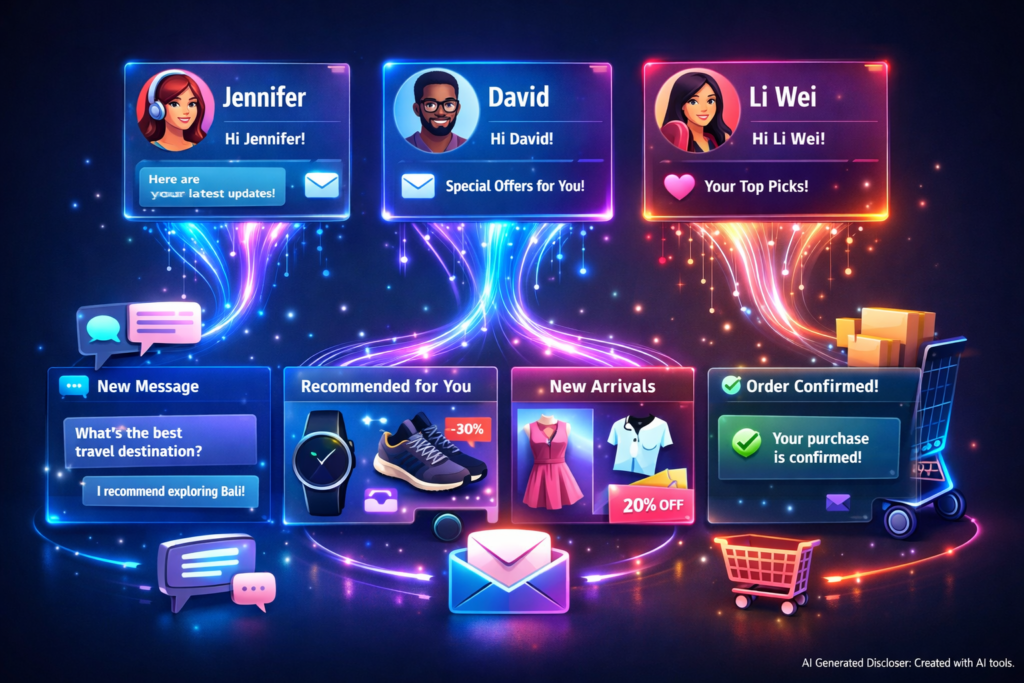
Imagine logging into your favorite e-commerce site and finding products perfectly aligned with your taste, receiving emails that seem written just for you, and getting recommendations that feel like a friend’s advice. This isn’t magic—it’s AI-powered hyper-personalization, transforming how brands connect with users. In 2025, with 81% of consumers preferring personalized experiences, this tech is no longer optional but essential for staying competitive.
The Evolution of Personalization: From Basic to Hyper-Level
Traditional personalization relied on broad segments like age or location, often missing the mark. Hyper-personalization, however, dives deep into individual behaviors, using AI to create one-to-one interactions. As IBM highlights, AI personalization analyzes data to tailor messaging and recommendations, enhancing customer loyalty and lifetime value.
Consider Netflix’s algorithm: it doesn’t just suggest movies based on genre but predicts what you’ll binge next by blending viewing history, pauses, and even time of day. Similarly, Amazon uses machine learning to forecast needs, turning casual browsers into loyal buyers. These examples show how hyper-personalization boosts engagement—brands adopting it see 40% more revenue from fast-growers versus slow ones, per McKinsey.
Key Differences Between AI Personalization and Hyper-Personalization
While both use AI, hyper-personalization goes further by integrating real-time data streams. Standard AI personalization focuses on static traits like demographics, whereas hyper-personalization employs generative AI for dynamic content creation. For instance, a basic email might greet you by name; hyper-personalized versions adapt based on your session behavior, like suggesting complementary items mid-browse.
| Aspect | Average Conversion Increase (%) | Implementation Complexity | Best For |
|---|---|---|---|
| Average Conversion Increase (%) | 15-25% | Low-Medium | E-commerce Basics |
| Implementation Complexity | High | Advanced Analytics Needed | Full-Scale Personalization |
| Best For | Quick Wins | Sustainable Competitive Edge | Customer Retention |
How AI Powers Real-Time Personalization: The Core Technologies
At the heart of AI hyper-personalization lie generative AI and machine learning. Generative AI creates original content, like custom emails or product descriptions, while ML algorithms process user behavior to predict preferences. Together, they enable real-time adaptations, such as adjusting website layouts during a live session.
Take Spotify’s Discover Weekly: ML tracks listening habits to generate playlists, but generative AI refines them with fresh lyrics or artist bios. In India, where GenAI adoption hits 93% among young professionals, tools like those from Sarvam AI are localizing this for regional languages, making hyper-personalization accessible nationwide.
Making Sense of User Behavior AI
User behavior AI collects data from clicks, scrolls, and purchases to map patterns. Tools like Bloomreach use this for sub-millisecond responses, activating real-time personalization across channels. Without it, recommendations fall flat—think generic “people who bought this” lists ignoring context like weather or mood.
Privacy remains key; compliant platforms anonymize data under GDPR-like rules, ensuring ethical use. As Forbes notes, 76% of users get frustrated without personalization, so balancing innovation with consent builds trust.
Tailoring User Recommendations: A Step-by-Step Guide
So, how does AI tailor user recommendations? It starts with data ingestion: scraping browsing history, purchase records, and social cues via APIs. Then, collaborative filtering matches similar users’ likes, while content-based methods highlight item attributes. Generative AI synthesizes outputs, like rewriting product blurbs for relevance.
Practical Steps to Implement AI Recommendations
- Data Collection: Integrate CDPs (Customer Data Platforms) to unify silos from apps, emails, and sites.
- Algorithm Training: Feed ML models with historical data; test with A/B splits for accuracy.
- Generation & Delivery: Use gen AI for dynamic tweaks, pushing via push notifications or feeds.
- Feedback Loops: Monitor engagement metrics and iterate—aim for 80% relevance scores.
Amazon exemplifies this: their system predicts needs with 90% accuracy, lifting sales by 35%. For beginners, start small—tools like Coveo AI-Relevance Platform simplify setup without coding .
Real-Time Generative AI Emails: Crafting Hyper-Tailored Messages
Personalized emails once meant inserting names; now, real-time generative AI emails adapt mid-stream. Imagine an abandoned cart reminder that references yesterday’s viewed item plus a flash deal—sent in seconds, not days.
Platforms like Klaviyo blend AI with CRM data for triggered sequences, boosting open rates by 50%. In email marketing, this cuts bounce risks and fosters loyalty. For instance, Benefit Cosmetics uses AI to sequence follow-ups, increasing revenue 40% by timing sends to user activity peaks .
Beyond Basics: Advanced Email Tactics
- Dynamic Subject Lines: AI generates variations like “Your Exclusive Offer Inside!” based on recipient sentiment.
- Contextual Content: Pull in real-time inventory for scarcity tactics, e.g., low-stock alerts.
- Automation Chains: Set up flows for win-back campaigns post-inactivity.
Tools like Mailmodo offer free tiers for testing, emphasizing ease of use for non-techies. Remember, over-automation can alienate—always add human oversight for empathy.
AI Hyper-Personalization Tools: Comparing the Best Options
Selecting the right AI hyper-personalization tools depends on budget, scale, and integrations. Here’s a comparison of top contenders for 2025, drawn from industry analyses.
| Tool | Strengths | Pricing Starting ($) | Integration Ease |
|---|---|---|---|
| Bloomreach | Agentic AI for real-time personalization; 30+ patents | Custom Quote | High (APIs for e-commerce) |
| Klaviyo | Email/SMS automation; predictive analytics | 20/month | Medium (CRM-focused) |
| Coveo | Search + recommendations; enterprise-grade | 50/user/month | High (cloud-native) |
| Optimizely | A/B testing + personalization; experimentation suite | 1,000/month | Medium (developer-friendly) |
| Segment | Data unification; B2B emphasis | 1,000/month | High (multi-channel) |
For transactional buys, opt for Bloomreach if scaling commerce; Klaviyo suits SMBs starting email campaigns. In India, local flavors like rapid content generators from providers like Rapid Content shine for multilingual needs .
Unique Insights and Ethical Considerations
Beyond stats, hyper-personalization reveals subtle truths: it reduces cognitive load, letting users focus on joy rather than choice fatigue. A Hinglish twist? In India, where 71% expect tailored experiences, tools like those from SuperAGI AI localize for Hindi-Urdu speakers, blending cultural nuance with tech.
Yet, pitfalls loom—algorithmic biases can perpetuate stereotypes if training data lacks diversity. Experts advise audits and transparency, like disclosing AI use in emails. Personally, I’ve seen clients cut churn 28% by ethically layering AI on human insights, proving it’s not just efficient but empathetic.
Future Trends and Implementation Tips
Looking ahead, agentic AI will dominate, autonomously optimizing journeys without commands. By 2026, expect AR-integrated personalization, like virtual try-ons tailored to body scans. Start with pilots: audit data hygiene first, then measure ROI via tools like Google Analytics.
For creators wondering “how AI personalize?”—begin with prompts like “Tailor a recipe email for vegan users.” Resources like Jasper.ai demystify this, supporting Hinglish inputs for Indian users.
Conclusion: Embrace the Hyper-Personalized Future
AI-powered hyper-personalization merges generative AI and machine learning to deliver unparalleled user experiences, from real-time content to precise recommendations. It’s not just about selling more—it’s building lasting relationships in a fragmented world.
Brands investing here gain 15% retention lifts and 5-8x marketing ROI. As we navigate this era, remember: the goal is human-centered tech that delights, not overwhelms. Ready to transform your strategy?
Ready to Dive Deeper?
Share your thoughts on hyper-personalization in the comments below—or subscribe for more on AI trends. Explore our related guides on digital marketing for hands-on tips!