
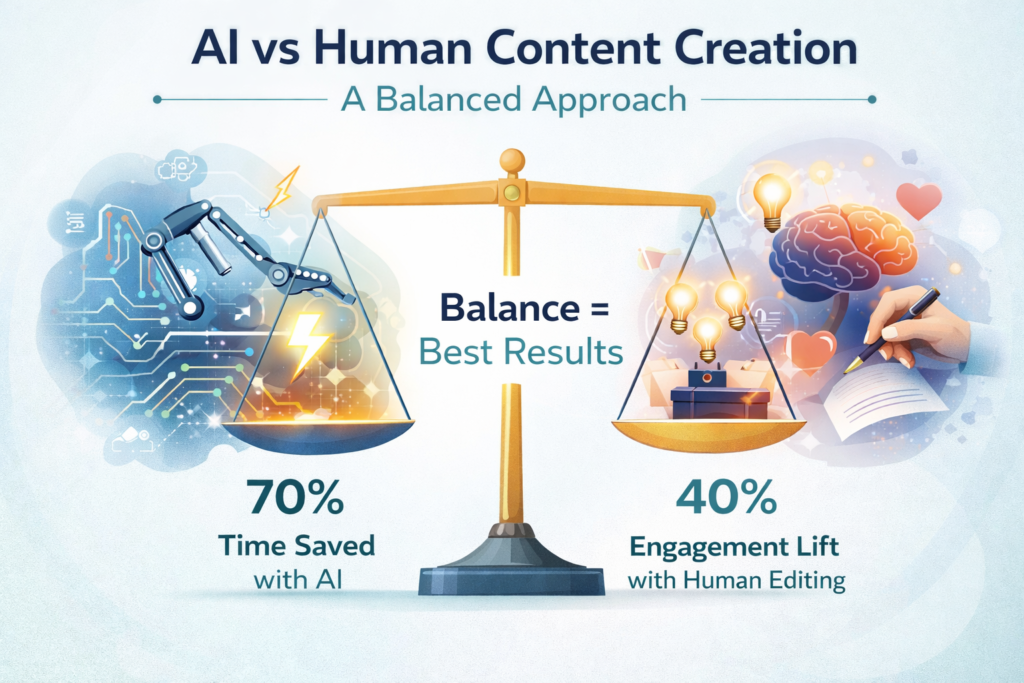
The debate between the lightning speed of AI content creation and the irreplaceable originality of human creativity is reshaping the digital landscape. For Indian bloggers, marketers, and small businesses, navigating this evolving terrain isn’t just about choosing one over the other; it’s about finding the sweet spot where both thrive. Can AI content rank in Google India without human editing, or is the human touch still paramount?
As we delve into AI content creation vs human creativity, this article will equip you with practical strategies and real-world examples to harness the power of both, ensuring your content stands out, resonates with your audience, and drives results in the dynamic Indian market.
 Striking the perfect balance between AI-driven efficiency and human creativity for impactful content strategies.
AI Content Creation vs Human Creativity: Why the Debate Matters
The rapid advancements in AI have ignited a crucial conversation in the content world: the inherent conflict between AI’s efficiency and human originality, and the tension between scalability and authenticity. Understanding this core dichotomy is the first step towards establishing a balanced and effective content strategy. This isn’t just a philosophical discussion; it impacts content quality AI vs human and ultimately, your brand’s resonance.
AI content creation tools promise unprecedented speed and scale, capable of generating vast amounts of text in mere moments. However, concerns about content originality and authenticity persist. Can machine learning in writing truly capture the nuances that define compelling content?
The Rise of AI Writing Assistants
AI writing assistants are digital tools that leverage artificial intelligence to help generate text, brainstorm ideas, and optimize content. These tools, like Jasper, Copy.ai, and Writesonic, operate on complex algorithms and large language models (LLMs). They analyze vast datasets of existing text to recognize patterns, grammar, style, and context, allowing them to produce coherent and contextually relevant content based on user prompts.
The best AI content generator tools can significantly accelerate various content tasks, from drafting blog posts and social media updates to creating product descriptions and marketing copy. They work by predicting the most probable next word or phrase, constructing sentences, and paragraphs that mimic human-like writing styles.
What Humans Bring That AI Cannot (Yet)
While AI excels at pattern recognition and data processing, human creativity in writing introduces elements that AI struggles to replicate. Humans bring **emotional depth** through lived experiences, allowing them to craft narratives that genuinely connect with an audience on a deeper level. Our ability for creative problem-solving enables us to approach content challenges with unique perspectives, leading to truly innovative solutions.
Crucially, humans understand **cultural nuance**, a vital component for storytelling with AI, especially in diverse markets like India. The ability to infuse humour, understand local idioms, and grasp subtle social contexts remains a uniquely human forte, ensuring content is not just accurate but also resonant and culturally appropriate.
Head-to-Head Comparison: AI vs Human Content
Understanding the strengths and weaknesses of both human and AI-generated content is crucial for developing a balanced strategy. This section provides a direct comparison to help you evaluate where each excels, particularly concerning human vs AI SEO and content quality AI vs human. A key question for many is: can AI content rank in Google India without human editing?
SEO Performance: Does Google Prefer AI or Human Content?
Google’s algorithms, particularly with updates like the Helpful Content Update, increasingly prioritize content that demonstrates E-E-A-T (Experience, Expertise, Authoritativeness, and Trustworthiness). While AI can produce SEO-optimized text, human oversight is critical for achieving high AI content quality scores and ensuring the content genuinely helps users. In India, where specific cultural and regional search behaviors exist, human editors are essential to infuse content with local context and genuine authority to rank effectively.
**What does Google say about AI content?** Google has stated that content created primarily for search engine rankings, regardless of whether it’s human-generated or AI-generated, is against its guidelines. However, content created by AI that serves to help people and demonstrates E-E-A-T can perform well in search results, provided it meets quality standards.
Originality & Plagiarism Risks
Content originality is a significant concern with AI content creation. AI models learn from existing data, which can sometimes lead to what are termed “AI hallucinations” – instances where the AI generates plausible but factually incorrect information. There’s also the risk of unintentional duplication issues, as AI might inadvertently reproduce phrases or ideas from its training data. Therefore, human fact-checking and thorough editorial oversight are indispensable to verify information and ensure the uniqueness of content, mitigating risks associated with AI content detection.
Speed vs Depth
The primary advantage of AI is its speed; it can generate vast amounts of content in minutes. However, this often comes at the expense of depth and nuanced research, which human writers excel at. While AI can quickly compile information, humans are better equipped to analyze, synthesize, and add a unique perspective that creates truly insightful content.
| Criteria | AI Content | Human Content |
|---|---|---|
| Speed | Seconds to minutes | Hours to days |
| Originality | Pattern-based, can repeat | Unique, experience-driven |
| SEO optimization | Excellent with prompts | Requires manual effort |
| Cultural relevance (India) | Often misses local nuance | Naturally understands festivals, idioms, humour |
| Cost | Low (subscription) | Higher (freelancer/agency) |
| Risk of factual error | Moderate to high | Low with research |
How to Balance AI and Human Writing (Practical Strategies)
Finding the right balance AI and human writing is not about replacing one with the other, but about creating a synergistic workflow. For Indian blogs and businesses, integrating AI effectively can boost efficiency while preserving the critical human touch. This section provides actionable frameworks for a hybrid content strategy.
The 70/30 Rule for Indian Blogs
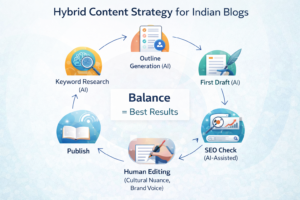
For Indian blogs, a practical approach to how to balance AI and human writing involves the 70/30 rule. Use AI for approximately 70% of the content generation process: this includes initial research, outlining articles, generating first drafts, and brainstorming ideas. This leverages AI’s speed and efficiency. The remaining 30% is where human creativity shines: localizing content, refining the brand voice, adding unique insights, emotional depth, and conducting thorough editing. This ensures AI content for Indian blogs resonates authentically.
Humanizing AI Text for Indian Readers
To truly connect with Indian readers, humanizing AI-generated content is paramount. This involves going beyond generic statements to incorporate regional references that resonate deeply, such as mentioning specific festivals like Diwali or Holi in campaigns, using local idioms, or weaving in cultural storytelling elements. Adding an emotional hook, perhaps a personal anecdote or a common local experience, injects the necessary human touch in content and reinforces brand voice consistency. This makes the content relatable and memorable.
Hybrid Content Strategy for Small Indian Businesses
Implementing a best hybrid content strategy for small Indian businesses involves a structured workflow that maximizes both AI efficiency and human effectiveness. Start with AI to generate initial drafts or research summaries. Next, a human editor steps in for thorough review and refinement, ensuring editorial oversight and injecting cultural nuances. An SEO expert then optimizes the content with relevant keywords and local search intent. Finally, a cultural reviewer ensures the content is sensitive, appropriate, and genuinely appealing to the target Indian audience. This multi-step process also allows for content personalization, tailoring messages to specific segments.
Tools to Use
- AI Writing Assistants: Jasper, Copy.ai, Writesonic, ChatGPT (for quick drafts, brainstorming, outline generation).
- Human-Assisted Polish & SEO: Grammarly (for grammar and style checks), SurferSEO, SEMrush (for in-depth SEO analysis, keyword optimization, and content scoring).
Case Studies & Examples (India Focus)
Practical examples demonstrate the tangible impact of integrating AI and human creativity. These case studies highlight how Indian businesses are navigating the challenges and opportunities, particularly whether AI content can rank in Google India without human editing and the importance of humanizing AI-generated content for Indian readers.
Case Study 1: A Delhi-based E-commerce Blog
A Delhi-based e-commerce brand initially relied solely on AI for generating product descriptions and blog posts. While efficient, they observed low engagement rates and conversions. The content was factually correct but lacked warmth and cultural relevance. Upon implementing a human-AI collaboration model, they began using AI for initial drafts of product descriptions, but then had human writers infuse them with customer testimonials, local shopping experiences (e.g., “perfect for your next family Diwali gathering”), and relatable narratives. This hybrid approach led to a 40% increase in click-through rates (CTR) on product pages and significantly higher time-on-page for their blog articles.
Case Study 2: AI-Only Blog vs Hybrid Blog (Ranking Experiment)
A digital marketing agency in Bengaluru conducted an experiment: one blog used purely AI-generated content, while another adopted a hybrid model. Initially, both blogs saw similar ranking improvements due to keyword optimization. However, after about three months, the AI-only blog’s rankings started to drop. Google’s algorithm, particularly after updates focusing on E-E-A-T and helpfulness, seemed to de-prioritize content lacking genuine human insights and unique perspectives. The hybrid blog, with human editors refining AI drafts, adding expert commentary, and ensuring cultural nuances, retained and even improved its rankings, demonstrating that the blend of AI efficiency and human depth yields sustainable SEO performance.
The Future of Content Creation: Human-AI Collaboration
The future of content creation is not a zero-sum game between AI and humans; it’s a collaborative synergy. Addressing questions about whether AI will replace writers in India and how to approach ethical AI in content is crucial for understanding this evolving landscape.
Will AI Replace Writers in India?
The simple answer is no. AI content creation vs human creativity is not a battle of replacement but one of augmentation. While AI can handle repetitive tasks and generate initial drafts with incredible speed, it cannot fully replicate the nuanced understanding of human emotion, cultural context, and original thought. Writers who embrace AI as a powerful assistant will likely thrive, using it to enhance their productivity and focus on higher-value creative tasks. Those who resist technological integration, however, might find themselves at a disadvantage. Upskilling in AI prompting and editing is becoming an essential skill for content professionals.
Ethical AI Use in Content
As AI becomes more integrated into content workflows, ethical considerations, especially concerning content originality, become paramount. Transparency is key: businesses should consider disclosure policies for AI-generated content, letting readers know when AI has been used. Vigilance against misinformation and ensuring factual accuracy through human verification is critical. Respecting copyright and intellectual property in AI training data and outputs is also a growing concern that businesses must address proactively to maintain trust and credibility.
Actionable Tips for Bloggers & Small Business Owners
For bloggers and small business owners in India looking to leverage AI tools for blog writing while maintaining a human touch in content and mastering storytelling with AI, here are seven actionable tips:
- 1. Start with AI for keyword research and outlines: Use AI to identify trending topics and structure your articles efficiently, saving valuable time.
- 2. Never publish AI text without human editing: Always fact-check and refine the tone to match your brand voice consistency and target audience.
- 3. Use AI to break writer’s block – finish with your own voice: Let AI generate initial ideas or paragraphs, then infuse them with your unique perspective and storytelling.
- 4. Add local Indian examples, stats, or case studies manually: Personalize your content with relevant, regional data and stories to resonate more deeply.
- 5. Run AI-generated content through plagiarism detectors: Ensure originality and avoid unintentional duplication issues before publishing.
- 6. Maintain a brand style guide for consistency: Guide both human writers and AI prompts to ensure all content aligns with your brand’s unique identity.
- 7. Test hybrid content in Google Search Console – track ranking differences: Continuously monitor the performance of your AI-assisted and purely human content to refine your strategy with editorial oversight.
Frequently Asked Questions
Can AI truly replace human writers for creative tasks?
No, AI cannot fully replace human writers for complex creative tasks. While AI content creation can generate ideas and drafts, it lacks genuine emotional intelligence, original thought, and the nuanced cultural understanding essential for truly compelling and authentic storytelling.
How important is human editing for AI-generated content in India?
Human editing is critically important for AI-generated content, especially for Indian audiences. It ensures cultural relevance, factual accuracy, brand voice consistency, and injects the emotional depth needed to connect with readers and maintain high content quality AI vs human standards.
What is the best hybrid content strategy for small Indian businesses?
A best hybrid content strategy for small Indian businesses involves using AI for efficient content generation (research, outlines, first drafts) and humans for refinement, localization, fact-checking, and infusing cultural nuance and brand personality to ensure maximum impact and authenticity.
How can I humanize AI-generated text for Indian readers?
To humanize AI-generated content for Indian readers, integrate local idioms, regional references (like festivals or landmarks), and relatable anecdotes. Focus on emotional storytelling, ensure cultural sensitivity, and align the tone with local communication styles to build stronger connections.
Does AI content creation impact SEO rankings in India?
Yes, AI content creation can impact SEO rankings. While AI can optimize for keywords, Google prioritizes helpful, high-quality content demonstrating E-E-A-T. Without human review and enhancement for accuracy, originality, and cultural relevance, AI-only content may struggle to rank effectively in competitive Indian search results.
Conclusion
The future of content lies not in a battle between AI content creation vs human creativity, but in their harmonious collaboration. For Indian bloggers and businesses, striking this balance AI and human writing is the key to unlocking unprecedented efficiency without sacrificing authenticity. By strategically combining AI’s analytical power with human ingenuity, cultural understanding, and emotional intelligence, you can create content that not only ranks high but also deeply resonates with your audience. The future of content creation is hybrid, intelligent, and distinctly human-powered.
What’s your hybrid content strategy? Share your insights below, or download our checklist for balancing AI and human writing in your content workflow!
AI Hyper-Personalization Tools: Leveraging Generative AI and Machine Learning for Real-Time Personalization
Unlocking Growth: How AI Is Transforming Digital Marketing Strategies